


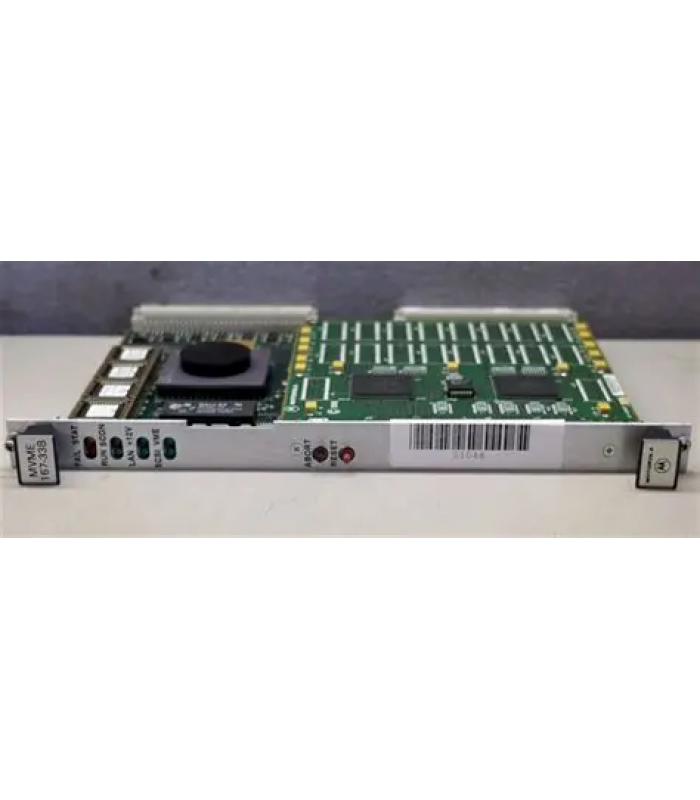
Motorola MVME167-33B VMEbus 6U Single Board Computer (MC68040 33MHz 68K Legacy Main CPU for Foxboro I A & Ovation DCS)
- Product Code: MVME167-33B
- Availability: In Stock
Motorola MVME167-33B VMEbus 6U Single Board Computer (MC68040 33MHz 68K Legacy Main CPU for Foxboro I/A & Ovation DCS)
Manufacturer Background: Motorola Computer Group → Freescale → Emerson Embedded Computing; Fully EOL discontinued, no new factory production; only refurbished/tested spare modules for legacy VME DCS racks
Part Number: MVME167-33B (-33 = 33MHz MC68040 CPU; B = standard ECC DRAM + Ethernet + SCSI full-featured variant)
Product Type: 6U double-height VMEbus real-time main SBC, full 32-bit VME master/slave controller; integrated CPU, memory, Ethernet, SCSI, multi-serial ports, watchdog timer; core process control processor for 1990s VME DCS systems
Matching Platform: VMEbus Rev B IEEE 1014-1987 backplane; Foxboro I/A Series, old Emerson Ovation VME racks, particle accelerators, aerospace ground test, medical CT scanners, offshore Zone2 hazardous control systems; compatible with MVME374 Ethernet coprocessor, all 68K MVME series I/O boards
Core Hardware Overview:
1. CPU: MC68040 33MHz 32-bit CISC, integrated MMU + hardware FPU, 36.8 MIPS, 4.5 MFLOPS, 8KB unified L1 cache
2. Memory: Standard 16MB 32-bit interleaved ECC DRAM (expandable to 64MB); 4×PLCC ROM sockets max 4MB firmware flash; 128KB battery-backed NVRAM with RTC real-time clock
3. VME Interface: Full 32-bit master/slave, A16/A24/A32 addressing, D16/D32 dynamic bus width, 8-level bus arbitration, 7 hardware IRQ priorities, 32-bit burst DMA
4. Network: 1×10Mbps AUI 10BASE5 Ethernet MAC with DMA offload (coax thicknet, external transceiver for twisted pair)
5. Storage: Onboard SCSI-2 controller for local hard disk/tape historical data logging
6. Local I/O: 4×isolated EIA-232-D serial ports (configurable RS422/485); 1×Centronics bidirectional parallel printer port
7. Timing & Safety: Four 32-bit programmable timers + hardware watchdog reset timer
8. Front Panel LEDs: RUN, FAIL, LAN, SCSI, VME bus status indicator lights
9. Mechanical: Standard 6U double-height Eurocard; supports MVME712 series RTM rear transition modules for full rear breakout wiring
10. Power: +5V 3.5A typical / 6.5A max, ±12V auxiliary via VME backplane; typical power consumption <20W
1. Product Overview
MVME167-33B is the flagship high-performance 68K VME single-board main controller launched by Motorola in the 1990s, widely deployed as the primary computing core for thermal power plant Foxboro I/A and early Emerson Ovation VME DCS control racks.
Equipped with integrated MC68040 floating-point unit, it natively executes complex closed-loop PID process control algorithms, SOE event sequence timestamp logic, and ESD safety interlock calculations without external coprocessors. The ECC error-correcting memory eliminates single-bit memory corruption failures during long-term unattended operation, a critical reliability feature for continuous industrial process systems.
It integrates independent SCSI local storage to cache historical alarm records, process curves, and unit startup/shutdown data, reducing reliance on upper HMI servers. The quad galvanically isolated serial ports support direct communication with field transmitters, local operator panels, and maintenance consoles. Paired with MVME374 dedicated Ethernet coprocessor, it separates real-time control tasks from heavy TCP/IP network traffic to eliminate network latency risks.
Compatible with VMEbus Rev B legacy backplanes that cannot support later Rev C/D PowerPC SBCs like MVME3100, it remains the only drop-in replacement for aging original VME CPU boards in vintage power and petrochemical DCS. Conformal coated PCB variants meet ISA S71.04 Class G3 anti-salt/humidity standards for offshore Zone2 hazardous control room environments, operating from 0℃~+70℃ standard, -40℃~+70℃ ruggedized wide-temperature versions.
Motorola ceased mass production decades ago; all available stock consists of surplus unused or fully functionally refurbished spare units requiring bench testing before deployment in safety-critical DCS systems.
